Growth Fetish by Clive Hamilton
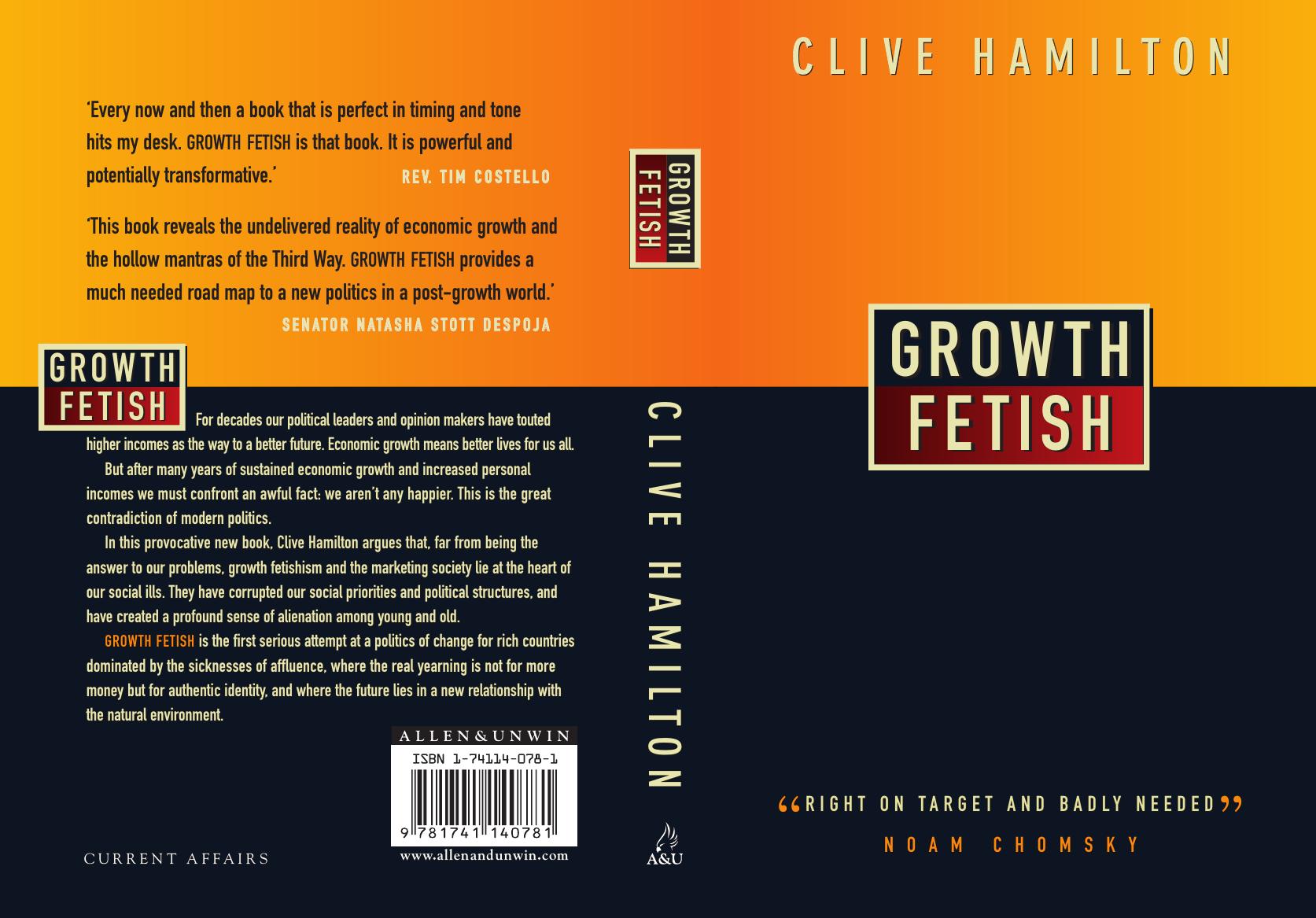
Author:Clive Hamilton
Language: eng
Format: epub, pdf
Tags: SOC000000, book
ISBN: 9781741150940
Publisher: Allen & Unwin Pty Ltd
Published: 2003-03-31T16:00:00+00:00
The power of economic ideas
The unwillingness of the champions of the Third Way to consider power is a disposition they share with the defenders of neoliberalism. Nor has the Third Way challenged the model of human wellbeing on which the economics texts are based. It has not questioned the utilitarian philosophy of modern economics and the marketing society, the sovereignty of the consumer and all the anthropocentrism, individualism, materialism and celebration of competition implied by it. It has not confronted the simple belief in progress, and it has everywhere succumbed to the allure of technology and economic internationalism. Neoliberalism could not persuade everyone that markets are inherently good and government intervention bad, but one of its legacies has been to persuade almost everyone that once markets are opened up governments become powerless to change things. In other words, while one might not like neoliberal policies, once they are implemented they are irreversible. A parallel belief is that globalisation has created international economic forces that have emasculated governments, and the consequent diminution of the power of the state has destroyed for ever the appeal of ‘old-style social democracy’. The traditional values of social democracy may remain admirable, but in the new globalised world those who still adhere to its political program are hopelessly utopian.
According to this view, modern politics is no more than a reconciliation with global economic reality. Giddens, for example, writes that the Third Way ‘refers to a framework of thinking and policy making that seeks to adapt social democracy to a world that has changed fundamentally over the past two or three decades’.13 Above all, it is the strictures on government that make the Third Way necessary, for globalisation has robbed social democracy of its most effective weapon, the power of the state. Of course, it is a great comfort to neoliberals that, whatever one might think about the desirability of globalisation, there seems to be nothing that can be done about it. If any government attempted to resist the trend it would be severely punished by ‘the markets’ and compelled to fall into line. Staying in line requires governments to pursue a suite of economic policies that keep the markets happy—fiscal discipline, tight monetary policy, limiting taxes on the wealthy, restraining trade unions through ‘labour market flexibility’, divesting the state of ownership of public enterprises, a general commitment to small government, removing restrictions on the free flow of goods and capital, and so on.
Although conservatives, including advocates of the Third Way, like to believe that these ideas are the robust conclusions of economics, they are in reality based on the questionable beliefs of a particular school of economics, the neoclassical school. In fact, the leading ideas of the economics establishment have been shown to be highly contestable, both by recent economic history and by formal economic studies. One of the defining features of neoliberal economics is its disdain for the evidence. After all, the superiority of free-market solutions has been demonstrated over and over by the cleverest in the profession.
Download
This site does not store any files on its server. We only index and link to content provided by other sites. Please contact the content providers to delete copyright contents if any and email us, we'll remove relevant links or contents immediately.
International Integration of the Brazilian Economy by Elias C. Grivoyannis(111312)
The Radium Girls by Kate Moore(12089)
Turbulence by E. J. Noyes(8110)
Nudge - Improving Decisions about Health, Wealth, and Happiness by Thaler Sunstein(7758)
The Black Swan by Nassim Nicholas Taleb(7193)
Rich Dad Poor Dad by Robert T. Kiyosaki(6727)
Pioneering Portfolio Management by David F. Swensen(6340)
Man-made Catastrophes and Risk Information Concealment by Dmitry Chernov & Didier Sornette(6138)
Zero to One by Peter Thiel(5863)
Secrecy World by Jake Bernstein(4794)
Millionaire: The Philanderer, Gambler, and Duelist Who Invented Modern Finance by Janet Gleeson(4535)
The Age of Surveillance Capitalism by Shoshana Zuboff(4352)
Skin in the Game by Nassim Nicholas Taleb(4305)
The Money Culture by Michael Lewis(4265)
Bullshit Jobs by David Graeber(4247)
Skin in the Game: Hidden Asymmetries in Daily Life by Nassim Nicholas Taleb(4050)
The Dhandho Investor by Mohnish Pabrai(3824)
The Wisdom of Finance by Mihir Desai(3788)
Blockchain Basics by Daniel Drescher(3622)
